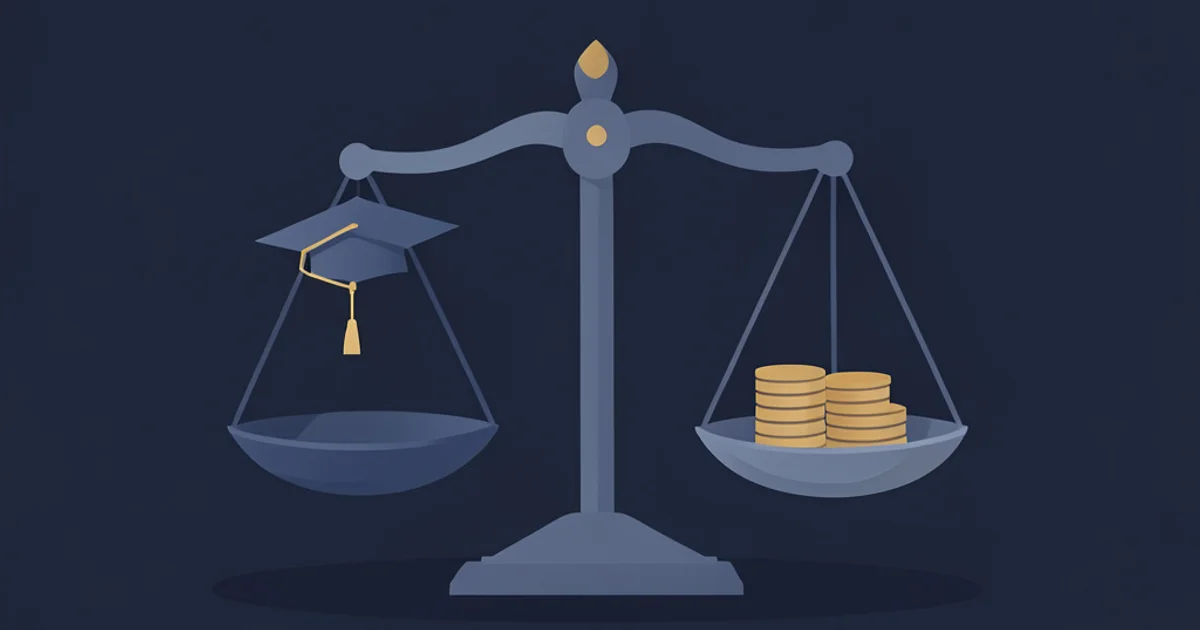
The Number That Changes Everything
Most law school applicants have a number in their head — a rough sense of what three years of law school will cost. Most of those numbers are wrong, and they are wrong in a direction that costs people years of financial recovery.
What Tuition Actually Costs
- Public in-state: $15,000–$35,000 per year.
- Public out-of-state: $35,000–$55,000 per year.
- Private (T-50 and below): $45,000–$58,000 per year.
- Private (T-14): $65,000–$73,000 per year. Several T-14 schools now exceed $70,000 annually.
Add living expenses and the annual cost of attendance at a private school in a major city routinely exceeds $95,000. Over three years, you are looking at $270,000 to $300,000 in total cost before interest.
Average law school debt at graduation is approximately $130,000 for public school graduates and $160,000 for private school graduates. Many graduates of full-pay private programs carry $200,000 or more.
The Salary Distribution Nobody Shows You
Legal salaries follow a bimodal distribution — two distinct peaks rather than a smooth bell curve:
- Big Law and federal clerkships: First-year associates at large firms start at $225,000 under the current Cravath scale.
- Public interest, government, small firm, and regional practice: $45,000–$75,000. This is where the majority of law school graduates land.
The gap between those two peaks is $150,000 per year. At most law schools, Big Law placement is 20–40%. That means 60–80% of graduates earn salaries that make $160,000 in debt difficult to service.
Break-Even Analysis
For a student entering law school at 24 who would otherwise earn $55,000 annually:
- Three years of foregone income: ~$165,000
- Three years of tuition and living expenses at a private school: ~$280,000
- Total investment: ~$445,000
If that graduate lands Big Law at $225,000, break-even occurs within 5–7 years. If that graduate lands at $65,000, break-even may not occur for 15–20 years.
Run the ROI numbers for your specific schools
AdmitBase's ROI calculator models debt load, expected salary, and break-even timeline across your school list — so you can make this decision with actual numbers.
Open the ROI calculator →Conditional Scholarships: The Risk Nobody Explains
Scholarship offers from law schools frequently come with conditions — most commonly a minimum GPA requirement (typically 3.0) that must be maintained each semester. Law schools grade on a mandatory curve. By definition, some students on conditional scholarships will fall below the required GPA through no particular fault of their own.
Before accepting any conditional scholarship, ask the school: what percentage of scholarship recipients retained their funding through all three years? Schools are required to report this data.
PSLF for Public Interest Lawyers
Public Service Loan Forgiveness was designed specifically for the salary/debt mismatch in public interest legal work. If you work full-time for a qualifying employer, make 120 qualifying payments on an income-driven repayment plan, the remaining federal loan balance is forgiven, tax-free.
Caveats: PSLF only covers federal Direct Loans. Private loans do not qualify. Keep meticulous records, certify your employment annually, and do not treat forgiveness as guaranteed.
ROI by School Tier
T-14 schools justify their cost for students who access Big Law or federal clerkships. For students who do not, the financial case for a T-14 versus a well-ranked regional school with significant scholarship money is weaker than the prestige premium implies.
Regional schools often provide excellent outcomes in their local markets at dramatically lower cost. A school ranked 50th nationally may have better employment outcomes in its specific region than a school ranked 20th.
The applicants who navigate law school cost most effectively are those who build school lists with scholarship potential as a genuine criterion and who use competing offers to negotiate. "Scholarship reconsideration" is the term schools use for this process. Most schools engage with it. A written offer from a peer school is the most effective leverage you will ever have, and it costs you nothing to ask.